Protecting Childhood: Insights for Parents & Communities

Last week, Catch the Wave of Hope shared our concerns about a federal appeals court ruling involving AI-generated child sexual abuse material. The ruling highlighted a growing problem: technology is changing faster than many of the laws designed to protect children, and laws need to be updated to address our current environment. This week, Florida took a significant step toward addressing part of that problem. On September 8, Florida Attorney General James Uthmeier announced proposed legislation that would hold companies that own, control, or distribute artificial intelligence systems accountable when those systems participate in criminal activity. The proposal would apply to companies with practical control over an AI system’s design, training, deployment, or safety settings. If convicted, a company could face substantial fines, payments to victims, and court-ordered monitoring. Why This Matters for Children For Catch the Wave of Hope, one part of the Attorney General’s announcement was particularly important. FDLE Commissioner Mark Glass specifically addressed AI-generated child sexual abuse material, stating that even fabricated material can cause serious harm. He shared that it can delay investigations, create new pathways for exploitation, and harm real children and families. That closely reflects the concerns we raised last week. AI-generated exploitation does not exist in a separate “virtual” world. Technology can be used to create abusive images, manipulate photos of real children, facilitate exploitation, and add enormous amounts of synthetic material to systems investigators already rely on to identify children who may be in danger. It can place an undue burden on organizations, such as our partner the National Center for Missing and Exploited Children, who work to help identify victims. Florida has already taken action in this area. Earlier this year, the state increased the penalty for creating AI-generated child sexual abuse material to a second-degree felony. Technology Can Change. Our Responsibility Cannot. AI offers tremendous possibilities. The challenge is making sure that innovation does not move forward without meaningful safeguards and accountability. When technology is used in ways that facilitate exploitation or put children at risk, our laws and safety systems need to be able to respond. The Attorney General’s proposal will now be part of a larger legislative conversation. The details matter, and lawmakers will have to determine how accountability should work in practice. But the larger conversation is one we believe Florida and the entire country needs to have. At Catch the Wave of Hope, our focus remains the same: prevention, education, awareness, and protecting children before harm occurs. Courts, lawmakers, technology companies, law enforcement, parents, schools, and community organizations all play and important role. Technology will continue to evolve, we must evolve our laws to adapt to the change. We promise our commitment to protecting children will never falter, we will always remain dedicated to meeting changes head-on, looking to always ensure our communities stay safe.
Sometimes, a single headline forces us to pause, catch our breath, and realize just how quickly the digital world is changing beneath our children’s feet. You may have seen the news about a deeply troubling federal appeals court ruling decided on August 25. A Wisconsin software engineer used artificial intelligence to generate hundreds of hyper-realistic, sexually explicit images of prepubescent children. The court ruled that the First Amendment protects the private, in-home possession of these AI-generated images, as long as they depict a "virtual" child rather than a real, living person. The appellate judges made it clear that their hands were legally tied to pre-internet precedents from 1969 and 2002—decisions written long before anyone could have imagined a computer program capable of generating flawless, lifelike abuse in seconds. In his ruling, Judge John Z. Lee issued a stark warning that "the law is being left behind" and pleaded with the Supreme Court to modernize these outdated guidelines. While creators and distributors of this material can still be prosecuted, this ruling leaves a dangerous loophole for possession. At Catch the Wave of Hope, we must be absolutely clear: virtual abuse is not a victimless crime. The Reality Behind the "Virtual" Myth Predators and offenders on dark web forums often try to justify their actions by saying, “At least I didn’t hurt a real child.” But child protection experts and advocates know that synthetic abuse is directly connected to real-world harm. It relies on the violation of real survivors: AI models do not create images out of thin air. They are trained on massive datasets scraped from the internet, which have been shown to contain actual, real-world abuse images. Predators are actively using AI to manipulate historical images of real survivors into new, more extreme scenarios—subjecting them to a terrifying, endless cycle of exploitation. It is actively used to blackmail local kids: Predators are using "nudify" apps to take normal, fully clothed photos of children from social media and digitally strip them to extort money or real explicit images. This is happening in schools right now. Thorn’s research reveals that 1 in 8 teens personally knows someone who has been targeted by an AI deepfake. It paralyzes the rescue pipeline: The sheer volume of synthetic abuse is overwhelming child protection systems. Generative AI reports to the National Center for Missing and Exploited Children (NCMEC) CyberTipline exploded from 4,700 in 2023 to over 400,000 in 2025 . Automated filters cannot catch these unique pixel patterns, forcing investigators to manually review hundreds of thousands of files just to tell the difference between synthetic and real children. This drains precious time away from locating and rescuing kids in active, physical danger. Standing Up on the Ground: Our Voice As advocates working directly in local schools, community groups, and neighborhoods, we know the real-world anxiety this technology causes. Kids are terrified; surveys show that 60% of young people are deeply worried about someone using AI to create inappropriate images of them. We refuse to wait for the legal system to catch up. Sarah Marie Henry, BSW, Executive Director: "Technology should never be used as a shield to excuse child exploitation. As advocates on the ground, we know that 'virtual' abuse is directly connected to real-world grooming. Our laws must evolve to protect children's futures, not the technology being used to exploit them." Kelly Laurine, Board Chair: "As a 100% community-funded grassroots non-profit, we aren't waiting for the legal system to catch up. Our commitment to protecting kids across the Treasure Coast is absolute, and we are doubling down on our front-line prevention work right now." How We Fight Back: Building a Shield of Prevention We believe with every fiber of our being that prevention is the single most powerful tool we have. While the courts debate and the laws crawl forward, we are actively in local classrooms, churches, and neighborhoods building a shield of protection: In local classrooms: We partner with the Monique Burr Foundation to teach Florida state-approved, age-appropriate safety lessons directly to students, helping them recognize online grooming and understand how to keep their digital lives safe. We are also Community Education Partners with the National Center for Missing and Exploited Children , which allows us to bring their Netsmartz & Kidsmartz Video Curricula into our community and schools when we educate. Equipping local families: We host free community trainings to help parents recognize online grooming tactics, set healthy digital boundaries, and understand the hidden dangers of the apps on their children's phones. Real, measurable impact: Through your support, we have already equipped over 5,000 local individuals across Martin County and the Treasure Coast with the tools they need to stay safe. We are going to keep showing up, we are going to keep educating, and we are going to keep standing between our children and those who wish them harm. But we cannot do it alone. Join the Wave of Hope Catch the Wave of Hope is a 100% community-funded grassroots organization. We don't rely on big government grants—we rely on neighbors, parents, and local businesses who care about the safety of our children. Here is how you can stand with us today: Talk to your kids: Have the hard conversations. Teach them about personal digital boundaries and reassure them they can always talk to you. Host a training: Bring our free safety and prevention training to your neighborhood group, school, or house of worship. Donate: Invest in front-line prevention to help us expand our safety programs to more local classrooms. If you want to learn how to protect your family or support our mission, please reach out to us at info@catchthewaveofhope.org or visit our website to get involved. Our kids deserve a safe childhood—online and off. Let’s build it for them, together. Quick Safety Resources for Families Report Exploitation: If you suspect child sexual exploitation or abuse (including AI-generated content), file an anonymous report immediately at CyberTipline.org . Remove Explicit Content: If a sexually explicit image of a minor—whether real or AI-created—has been posted online, use NCMEC's anonymous Take It Down tool at takeitdown.ncmec.org .

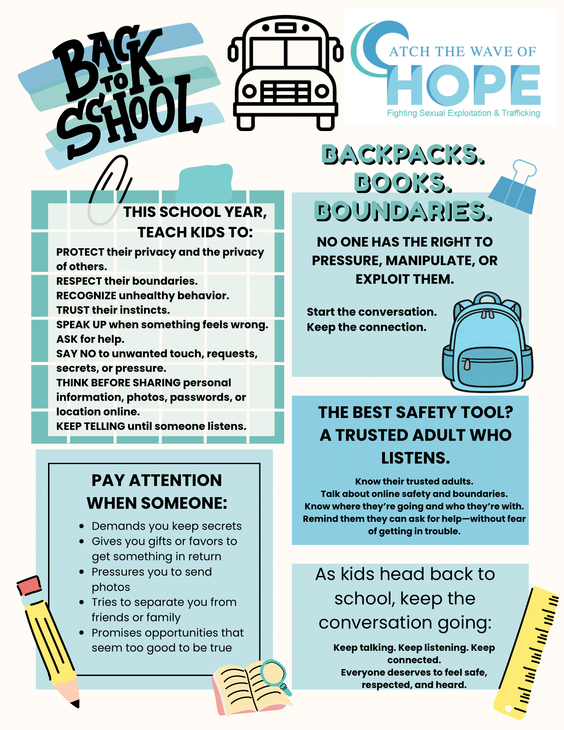
Talking to children about personal safety, boundaries, body autonomy, and unsafe situations can feel intimidating. Many parents worry about saying too much, using the wrong words, or frightening their child. But safety conversations don't have to be scary—and they don't have to happen all at once. The Monique Burr Foundation for Children (MBF) takes a prevention-focused approach that gives children practical tools to recognize unsafe situations, respond appropriately, and seek help. Its programs are built around the MBF 5 Safety Rules and the concept of Safe Adults—trusted people children can turn to when they feel unsafe, have been hurt, or simply aren't sure about a situation. The goal isn't to teach children that the world is dangerous. It's to help them understand that their safety matters, their voice matters, and they can ask for help. Start Early—and Keep Talking One of the most important ideas in prevention education is that safety shouldn't be a single "big talk." Instead, make it part of everyday family life. You might talk about boundaries while your child is getting ready for school, discuss online safety when they receive a new device, or practice what to do if they become separated from you while you're out. MBF emphasizes ongoing, two-way communication so children feel comfortable asking questions and telling a trusted adult when something doesn't feel right. The younger the child, the simpler the language can be. Try: "Your body belongs to you." "You get to tell someone when you don't want a hug." "You can always tell me if something makes you uncomfortable." "You will never be in trouble for telling me about something that happened." These simple statements establish a foundation that can grow with your child. Use the MBF 5 Safety Rules as Conversation Starters The MBF 5 Safety Rules provide an easy framework for talking about safety without turning every conversation into a warning or lecture. Know What's Up Know What's Up means being aware of the people, places, and situations around us—both offline and online. With younger children, this might mean teaching them their full name, your name, your phone number, and what to do if they become separated from you. With older children, the conversation can expand to include awareness of their surroundings, friendships, social interactions, apps, websites, and online behavior. Ask: "Who will be there?" "What would you do if you couldn't find me?" "Who could you call if you needed help?" "What would you do if someone you didn't know messaged you online?" You can also establish a family password that someone would need to know before your child goes with them unexpectedly. The purpose isn't to make children suspicious of everyone. It's to help them develop awareness. Spot Red Flags Children need to understand that unsafe situations don't always look frightening. Sometimes a red flag is a feeling of discomfort. Sometimes it's someone's behavior. Sometimes it's pressure, manipulation, secrecy, or someone ignoring a boundary. MBF specifically encourages conversations about personal space, boundaries, safe versus unsafe situations, secrets and tricks, correct names for private body parts, and digital safety. You might ask: "What would you do if someone kept tickling you after you said stop?" "What if someone told you to keep a secret from Mom or Dad?" "What if someone asked you to send them a picture that made you uncomfortable?" "What if an adult told you that you would get in trouble if you told someone what happened?" Help your child understand that a trusted adult should respect their boundaries and that secrets, pressure, threats, or attempts to make them uncomfortable can be red flags. It's also important to teach children that a red flag doesn't necessarily mean someone is "bad." It means the behavior or situation deserves attention. Make a Move Knowing something feels wrong is only the first step. Children also need to know what they can do next. Make a Move means taking action to get away from an unsafe situation when possible and making choices that increase safety. Practice simple scenarios with your child: You: "You're at a friend's house and an older child starts making you uncomfortable. What could you do?" Child: "I could leave." You: "Who could you go to?" Child: "A Safe Adult." Role-playing these situations can make the response easier to remember if your child ever encounters something uncomfortable or unsafe. And remind them: they don't have to handle everything perfectly. The responsibility for keeping children safe belongs to adults. Safety skills are tools—not a child's responsibility for preventing abuse or harm. Talk It Up Children need permission to use their voices. Talk It Up teaches children that they can say "no," speak up when someone violates their boundaries, and tell a Safe Adult about something unsafe or inappropriate. Practice phrases such as: "Stop. I don't like that." "No, thank you." "I don't want a hug." "That's my body." "I need to talk to my mom." "I don't feel safe." "I need help." This is particularly important when children are taught to automatically obey adults. We can teach children to be respectful without teaching them that they must ignore their own safety instincts to make adults happy. For example, instead of: "Give Grandma a hug." Try: "Would you like to give Grandma a hug, wave, or say hello?" This small change communicates a powerful message: affection is not something a child owes another person. No Blame | No Shame Perhaps the most important message parents can give their children is: "You can always tell me." MBF's fifth Safety Rule, No Blame | No Shame, emphasizes that children are not to blame when they are hurt or victimized, and that it is never too late to tell a Safe Adult. Children sometimes don't tell because they are afraid of getting in trouble, disappointing their parents, being blamed, or not being believed. So tell them explicitly: "If you ever make a mistake, you can tell me." "If someone tells you to keep something from me, you can still tell me." "If you think you're going to get in trouble, tell me anyway." "Even if you didn't listen to a rule, you can always come to me when you need help." And most importantly: "If someone hurts you, it is not your fault." This message should be repeated throughout childhood. Teach Boundaries by Respecting Them at Home Children learn boundaries not only from what we say, but from what we model. If a child says they don't want a hug, respect it. If they don't want to sit on someone's lap, don't force them. If they ask for privacy while changing clothes, give them appropriate privacy. And teach them to respect other people's boundaries too. You can say: "Just like you get to decide what happens to your body, other people get to decide what happens to theirs." This creates a two-way understanding of consent and respect: your boundaries matter, and other people's boundaries matter too. MBF similarly emphasizes teaching children to respect themselves and others while understanding personal space and boundaries. Help Your Child Identify Safe Adults No parent can be everywhere their child is. That's why children need a network of Safe Adults. A Safe Adult is someone they can talk to if they feel unsafe, have been hurt, or aren't sure whether something is unsafe. MBF also notes that if a Safe Adult no longer feels safe, children can choose another Safe Adult. Ask your child: "Who are three adults you could talk to if you needed help and I wasn't available?" Depending on their age and circumstances, this might include a teacher, school counselor, coach, relative, caregiver, or another trusted adult. The goal is not simply to give children names. Help them understand what makes someone a Safe Adult: someone who listens, takes them seriously, helps them get safe, and doesn't ask them to keep unsafe secrets. Don't Forget Digital Boundaries Personal safety doesn't stop at the front door. Children and teens increasingly navigate friendships, games, social media, messaging, and other digital spaces independently. MBF's safety programs address digital abuse, cyberbullying, online dangers, and exploitation alongside in-person safety. Ask questions without immediately jumping into punishment: "Who are you talking to online?" "Has anyone ever made you uncomfortable?" "Has anyone asked you to keep an online conversation secret?" "What would you do if someone sent you something inappropriate?" "What would you do if someone asked for a private picture?" "Who could you tell?" Your goal is to make yourself the person they come to before a problem becomes a crisis. Practice, Don't Just Explain Children learn safety skills through repetition. Try short role-plays during everyday moments: Scenario: Someone wants a hug. Practice: "What could you say if you don't want one?" Scenario: Someone online asks you to keep a conversation secret. Practice: "What red flag do you notice?" Scenario: You are somewhere and suddenly feel uncomfortable. Practice: "What could you do? Who could you tell?" Keep the tone calm and matter-of-fact. You don't need to create frightening scenarios. The goal is to build confidence and familiarity. MBF emphasizes practice and reinforcement as part of its prevention programs because children benefit from actually using the skills they're learning. Most of All, Create a Culture of "You Can Tell Me" The strongest safety message isn't a rule. It's a relationship. Children need to know that when they come to us with something difficult, our first response will be to listen. If your child tells you something concerning, try to stay calm and say: "I'm glad you told me." "Thank you for telling me." "You did the right thing by coming to me." "This is not your fault." "I'm going to help you." Those words can matter enormously. Safety education isn't about teaching children to live in fear. It's about giving them language, confidence, awareness, and trusted relationships so they know what to do when something doesn't feel right. The MBF approach reminds us that prevention starts with education and empowerment. The more comfortable families become talking about boundaries, red flags, safe adults, and asking for help, the more natural these conversations become. You don't need to have one perfect conversation. Start with one question. Teach one skill. Practice one scenario. Then keep the door open. Because when children know they can use their voice, recognize red flags, seek help, and come to a trusted adult without fear of blame or shame, they have something incredibly valuable: the confidence to speak up and the knowledge that they don't have to face an unsafe situation alone. A Note for Parents The MBF 5 Safety Rules are copyrighted materials of the Monique Burr Foundation. This article summarizes the principles for general educational purposes and is not a reproduction of MBF curriculum materials. Parents who want to learn more can explore the Foundation's official resources and parent education materials. Catch the Wave of Hope is certified in the Monique Burr Foundation's K–12 prevention curriculum and provides prevention and education training free of charge to the community, including schools, churches, youth organizations, and other community groups. Our goal is to make these important safety conversations and prevention resources accessible to as many children, families, educators, and communities as possible. Explore the Monique Burr Foundation's parent and safety resources https://mbfpreventioneducation.org/